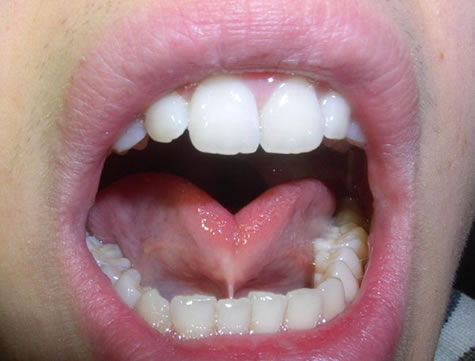
If after many hours of focused practiced you can’t master rolling your ‘r’s you may be unable to do it.
Some people just can’t seem to make the Spanish ‘erre’ sound no matter how hard they try.
In a small number of cases, the reason is ankyloglossia, commonly known as tongue-tie: reduced tongue mobility caused by a frenulum — the tissue connecting the tongue to the floor of the mouth — that is too short.
Many people born with this minor congenital condition undergo corrective surgery in childhood, but mild cases can go unnoticed well into adulthood.
If you suspect an undiagnosed tongue-tie—or if you plan to live long-term in a Spanish-speaking country—it may be worth seeing a speech therapist.
They can help determine whether the issue is anatomical, technical, or both, and whether the trill is something you can realistically master (or finally stop fighting with).
After all, sometimes the problem isn’t practice. It’s physics.
Still Can’t? Try the French ‘R’ Instead
Those who know Français know that the guttural French ‘R’ sound is formed by vibrating the back of the throat with the while exhaling.
A Spanish ‘rr’ uses the same concept except the tongue is vibrated on the roof of the mouth instead of vibrating the throat.
Despite this, many native French speakers who learn Spanish as adults also struggle with the double Spanish ‘r’ and automatically replace it with the guttural French ‘r’ while speaking Spanish.
A reasonable alternative if you think you’ll never be able to learn the Spanish ‘rr’ is to replace it with an exaggerated French ‘r,’ as in the French word, ‘arrête’.
This alternative sounds pleasant and because it does have a (guttural) trill it is a much closer approximation to the Spanish ‘rr’ than just producing a single English ‘r’ sound.
Additionally Argentines are famed for their Francophilia so doing your double ‘r’ French style will come off favorably.
In the end if you’ve tried your best and still can’t roll your ‘r’s perfectly, or have to do it French style, don’t let it discourage you.
Most people who aren’t native speakers have an accent; you’ll still be understood.





[…] if you can’t trill?: /2011/07/what-if-you-cant-trill-your-r/ Share this:FacebookEmailPrintStumbleUponLike this:LikeBe the first to like […]